
La Scontrosa S.r.l. is a film production company established in Trieste, Italy, in 2024. La Scontrosa's mission is to produce cinematically ambitious works through international co-productions, guided by a strong authorial vision and free from constraints in terms of genre or format.
The company develops projects ranging from documentaries and fiction films to animation, and from short films to feature-length productions. Committed to portraying a changing world, La Scontrosa prioritises stories that explore personal, social, and historical memory, and that lend themselves to international co-production through the universal appeal of their themes or cinematic language.
Believing that no transformation of society can take place without a corresponding evolution in perspective and cinematic language, La Scontrosa positions itself within the European film landscape as an incubator for emerging talent. Building on the founders' extensive experience in education and professional training, the company supports new generations of filmmakers by making the most of opportunities offered by the international market while also developing its own talent-development initiatives.
Giuseppe Gori Savellini
Giuseppe holds an MA and a PhD in Media History and is a subject-matter expert at the Department of Theories and Techniques of Journalistic Language at the University of Siena. He has collaborated with festivals and exhibitions as a curator and cultural planner, as well as with a film distribution and sales company. From 2019 to 2024, he was co-administrator of Tico Film Company Srl., where he was specifically involved in research and development, accounting, and production. Giuseppe attended ALPI Film Lab in 2021 and Green Film Lab in 2022, initiatives organized by TorinoFilmLab in collaboration with EAVE and ACE. He is co-founder of La Scontrosa Srl, a production company based in Trieste and established in 2024, where he is responsible for production strategies and executive production.
- 2025 | Vivere | 20 min | Producer
- 2023 | Alien Island | 87 min | Producer
Beppe Leonetti
Beppe Leonetti was born in Turin in 1977 and is an internationally award-winning film editor and producer. He graduated in Film Editing from the Centro Sperimentale di Cinematografia – National School of Cinema. A former EURODOC participant, he has extensive experience in both post-production and film production. Beppe has collaborated with Italian director Nanni Moretti, editing several of his documentaries and short films, including Il Diario di uno Spettatore, a segment of the feature film Chacun son Cinéma, presented at the Cannes Film Festival in 2009. In 2011, he edited Là-bas. A Criminal Education, directed by Guido Lombardi, which won the Lion of the Future Award at the 68th Venice International Film Festival. In 2012, he founded Il Piccolo Cinema in Turin, an experimental initiative aimed at bringing cinema to the city's underprivileged suburbs.
- 2025 | Nostalgia for the Future | 90 min | Producer, Editor | Cannes Classics
- 2024 | Noi siamo gli errori | 90 min | Producer, Editor
- 2023 | Amor | 90 min | Editor | Venice IFF
- 2020 | Bogre | 200 min | Producer, Editor
- 2019 | Kobarid | 100 min | Producer, Editor
Specters of the Camp
- Director
- Claudia Tosi
- Produced by
- La Scontrosa
- Duration
- 80'
- Genre
- Hybrid documentary (observation, animation, archive)
- Stage
- Development phase
- Supported by
Logline
Among the ruins of Italy's largest former concentration camp, the ghosts of an unresolved massacre that took place in 1944 still wander, reliving their final days. A team of historians and the descendants of the sixty-eight victims delve into the mysteries of this cold case to reconstruct the truth and seek justice, while Laura fights to ensure that her grandfather—an unexpected partisan and one of the 68 victims—is not forgotten.
Synopsis
The former Fossoli concentration camp welcomes visitors like a haunted castle. Among them is Laura, whose grandfather was killed in a massacre in 1944, together with 67 other political prisoners. Long forgotten and still shrouded in mystery, the massacre remains unresolved to this day.
Laura's grandmother entrusted her with keeping alive the memory of her beloved Carletto, after years of silence caught between the collective denial of Italy's Fascist past and respect for the grief and anger of Laura's mother, who felt betrayed by her father for giving his life for his ideals rather than staying safely at home with his family.
Laura guides students through the camp, reads her grandfather's letters from prison at small public events, and tells his story at commemorations and gatherings where less and less people show up. But who will keep his memory alive when she is gone?
During her visits to the camp, Laura meets other descendants of the victims. They have formed a community demanding truth and justice and calling on the historians of the foundation that manages the site to uncover what happened: why were the prisoners killed? Who ordered their deaths? Why was nobody punished? Eighty years later, the families are still seeking truth and justice. Eventually, the foundation funds an academic research project aimed at uncovering the truth. Led by Professor Pezzino, a team of historians delves into archives marked by omissions and lies, revealing decades of concealment and the long shadow of Cold War realpolitik.
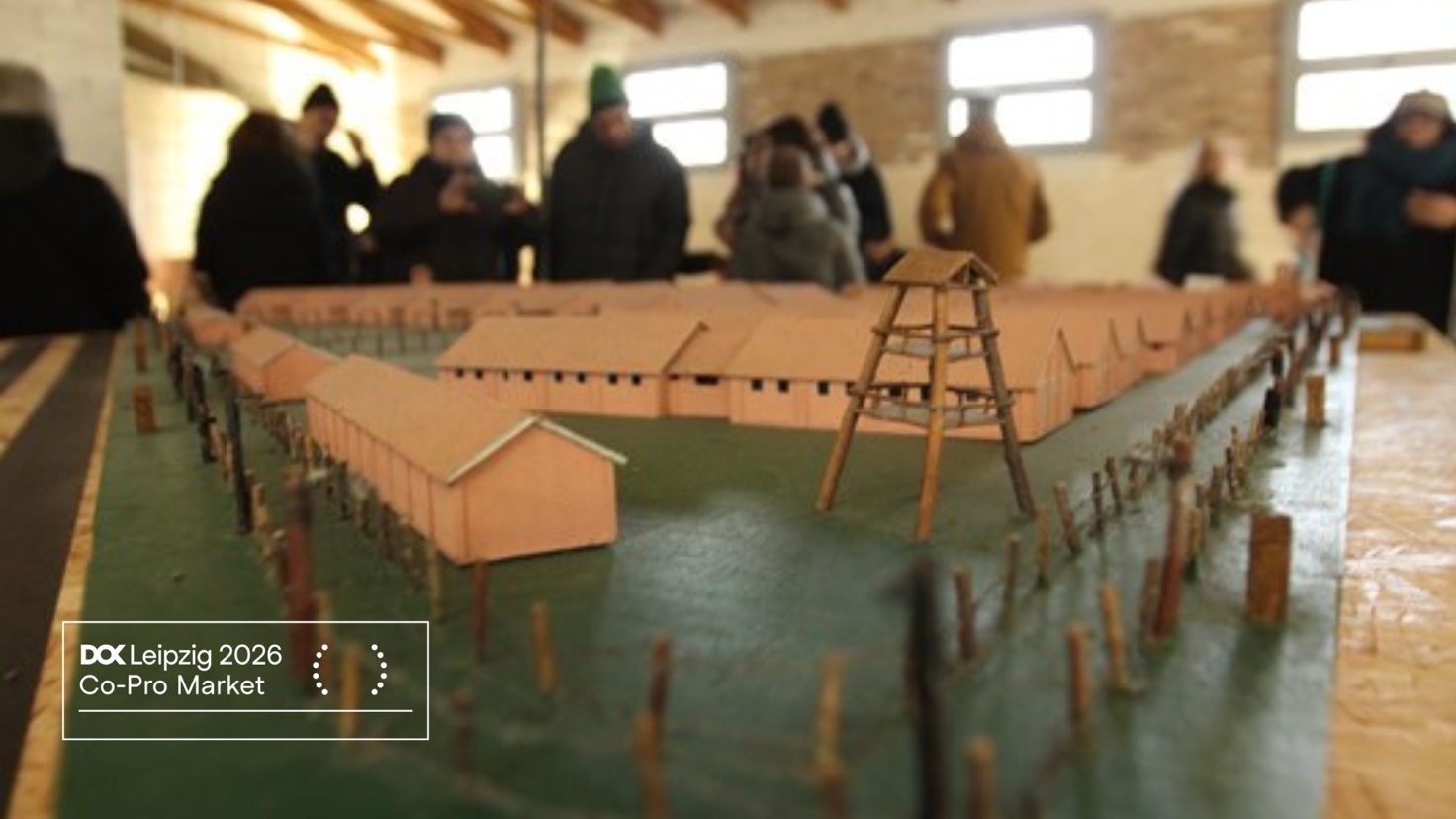
At Fossoli, past and present coexist. While the investigation unfolds, the Camp becomes a living organism, where animated scenes emerge from miniature models and drawings displayed throughout the site. Based on eyewitness testimonies—sometimes consistent, sometimes contradictory—these sequences bring to life the final days of the spectres of the massacre's victims, unaware of what awaits them. As fellow prisoners disappear before their eyes, they struggle to understand what is happening, they long for their loved ones, plan their escape, and reveal who they are beyond the label of victim.
It seems that everything unfolds under the watchful eyes of the spectres, but this is an illusion. The living search for the dead, yet cannot reach them, just as the dead cannot reach out to the living. As the research progresses, a rift emerges: historians can only follow the evidence, while the families cannot accept silence as an answer.
Blending observational cinema, archival material and animation, The Spectres of the Camp transforms Fossoli into a living museum where Laura and the other descendants strive to restore their loved ones to history and collective memory, so that they will not be forgotten when those who remember them are no longer here.
Beginning with a massacre that remains unresolved, the film becomes a reflection on the unequal struggle between individuals and history, asking what remains when justice fails, archives conceal the truth, and the past refuses to disappear.
Director's Note
I live just a few kilometres from the former Fossoli concentration camp. Walking among its ruins, I feel surrounded by ghosts who, like the spectre of Hamlet's father, wander in search of justice. Of all the crimes committed there, the massacre of the 68 political prisoners has always struck me most deeply, because with them died a future that never came. It is the ghosts of those victims that I feel walking beside me when I visit the camp.
In this story, I hear the echo of a fascinating idea by the French philosopher Jacques Derrida: that which is absent can persist in its spectral form, becoming more real than its bodily counterpart. I had been thinking of making a film set in the camp for many years, but I began working on the idea only when I met the victims' descendants, who are still asking for justice even though both victims and perpetrators are dead. I was fascinated by the conflict between them and historians: the former moved by emotion, the latter by reason.
I decided it would be a film about a reality inhabited by the ghosts of the past and about those who can dialogue with them, with animation as a crucial component. I imagined the camp as a sort of living museum, where objects would come to life, emphasizing how memory, historical objects and traces can create a reality wider than mere existence—where time and history are not linear but fragmented and disjointed, and where emotion becomes part of the discourse.
The animated scenes are never illustrative; rather, they represent the past repeating itself and reveal the human being behind the label of "victim". These sequences make up the majority of the film and intertwine with observational footage, establishing an ethical connection between the spectres' world and their families' reality: descendants feel responsible for an unredeemed past.
The Spectres of the Camp is not a historical film, but a film about history and the ghosts haunting the present—cinema itself being the most spectral of arts.
Claudia Tosi
Claudia Tosi holds both a BA and an MA in Philosophy. She has worked as a creative documentary filmmaker since 2003. In 2004, Claudia co-founded Movimenta, a production company focused on producing and internationally co-producing narrative documentaries. In 2011, she attended EAVE as a writer; in 2012, Eurodoc as a director/producer; in 2014, IDFA Academy; and in 2015, Berlinale Talents – Doc Station and EWA's MRSTP (Multiple Revenue Stream Training Program).
- 2024 | Mr. Beau | 84 min | Director
- 2018 | I Had a Dream | 80 min | Director, Producer | Golden Dove, FIPRESCI Award and Interreligious Jury Award - DOK Leipzig; Audience Award - Biografilm Festival
- 2015 | The Perfect Circle | 80 min | Director, Producer | Moral Approach Award - MakeDox
- 2009 | Mostar United | 75 min | Director | Nominee - PRIX EUROPA; Best Documentary - DoKMa
- 2004 | Private Fragments of Bosnia | 52 min | Director, Producer | Best Documentary - Genova Film Festival; Best Documentary – Mediterraneo Video Festival